My experience at ICN Vancouver 2026
By Louie Yip
As a second year PhD candidate (at the time of writing), I’ve been very grateful for the handful of opportunities I got to attend a conference and talk about science. It’s always fascinating to hear about what others work on from a diverse range of research fields, and sometimes I even get to present my own work through a poster or short talk. Thing is, up until now I’ve only been travelling within the country to attend these conferences. All of that was about to change when I received news that I was accepted for a talk at the International Congress of Neuroethology, scheduled to take place at Vancouver in late July of 2026. Seeing that notification in my inbox made me very excited, but also kind of terrified. It would be the very first time I’ve crossed the Atlantic ocean and stepped foot on one of the American continents. Above all, it would be the biggest conference that I’ve ever attended in my life, with an audience more specialised and probably more knowledgeable in the very field my own project is based on! Alas, I knew there was no way I would pass up such a thrilling opportunity, so without hesitation (and a bit of self-hyping) I registered my place at the event and booked my plane tickets.

A lovely view of downtown Vancouver. (not pictured: me scoffing down a lobster roll)
Admittedly, when I first made landfall on Vancouver, my only objective was to immediately slink to my conference accommodation and sleep off my jet lag as soon as possible. But as I regained my energy over the coming days of my stay, I got more opportunities to explore around the city, and only then I realised how uniquely gorgeous of a city Vancouver is. While the downtown area is a bustling glass cityscape, a bus ride can take you to various spots of lush and towering taigas. With the Strait of Georgia running across, you can get multiple different beach views with mountainous skylines that make for scenic sunset shots. The conference took place within the main campus of the University of British Columbia, a venue bigger than any I’ve seen before. Numerous buildings ranging from accommodation, departments and student hubs, altogether composing a campus that physically rivals the area of the city centre of Newcastle! While on the UBC campus, I also got to visit a number of exhibits such as the Museum of Anthropology and the UBC Botanical Garden, which made for nice breaks in between conference sessions. At various points across the campus I had also spotted some remarkable wooden totems, a form of artwork from the indigenous tribes that lived there long ago. Vancouver had so much to explore and so much history to learn, a pity I only had one week to be immersed in it all!
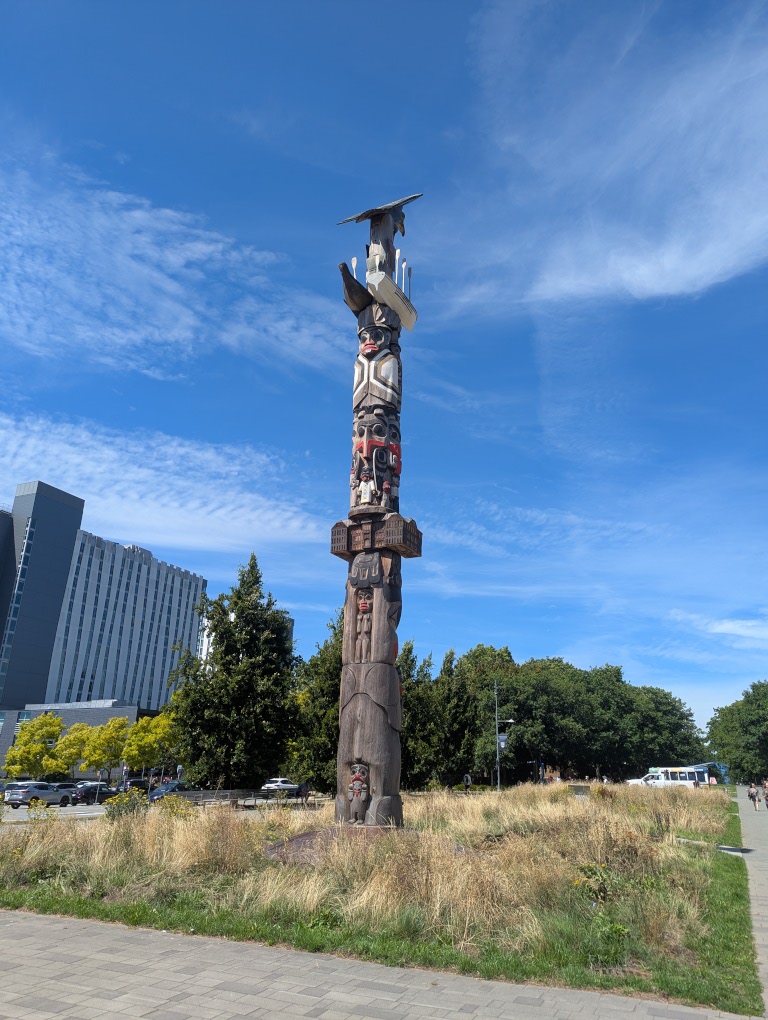
One of various totem poles stationed around the UBC campus.
Though I had limited time to explore Vancouver itself, the conference itself was unmistakably the highlight of my entire trip. Being a decently large conference, I got to meet a lot of different people far beyond the cohort I’m usually surrounded by, all of them researchers at all career stages coming from labs around the whole world. A lot of them were looking into some fascinating research in animals, ranging from flies, bees, cuttlefish, eels, songbirds, mice and more! Some of these projects took on a more neuroscience approach (e.g. neural recordings), while others leaned more on traditional animal behavioural research, but more commonly a blend of both fields were featured. That was the common theme uniting all these research topics and researchers together: Neuroethology. Research questions in neuroethology come in even more variety than the animal models being used, often diving deep into the function or mechanism of a particular aspect of behaviour, whether that be locomotion, sensory perception, or even complex tasks such as navigation or social interactions. Indeed, everyone attending the conference had come from a unique lab, each addressing a very specific direction of research, but all very eager to share their work and learn from each other. As someone who’s entire academic journey had so far been hyperfixated on a single facet of visual cognition in bumblebees, it was very eye-opening to see the sheer width one can explore in neuroethology!
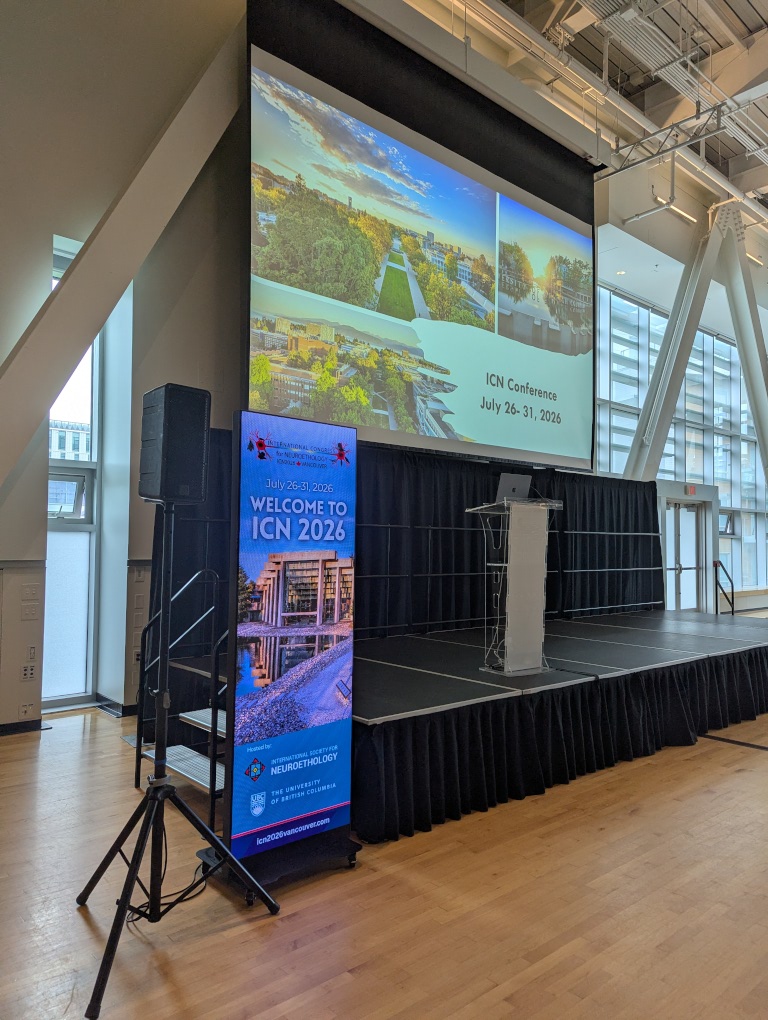
Another day at the conference is about to begin...
For how many researchers were attending the conference, the task of actually getting to know all of them and what they do would probably be quite intimidating. Luckily, the main bulk of the conference’s events were made up of 15 minute talks, where researchers were given a proper chance at introducing everyone to the work they’re so passionate about. I deeply appreciated all of these talks, not only about what kinds of questions these researchers are tackling and the scientific techniques, but also all the creative ways of expressing these complex research topics to a non-specialised audience. There were also the poster sessions that took place towards the end of the day, and while I thought those sessions were a bit chaotic, it did allow more opportunity for a proper conversation with the scientist and their research. Oh, and did I mention I was one of the speakers? I got my very own 15 minute presentation slot where I got to talk about the work I’m doing in my PhD project! I’ve spoken about my project in front of a public audience a few times before, and even though this was the largest crowd I’ve spoken to so far, I’m always delighted to be able to share my work with others and teach them a little bit about the impressive cognitive abilities of bees. The best part about presenting to this audience however was what came after: I received a handful of valuable feedback for my project from some researchers, while others approached me looking to network or form a collaboration. Ironically, sharing and talking about my research actually taught me more things and helped me form a lot of connections!
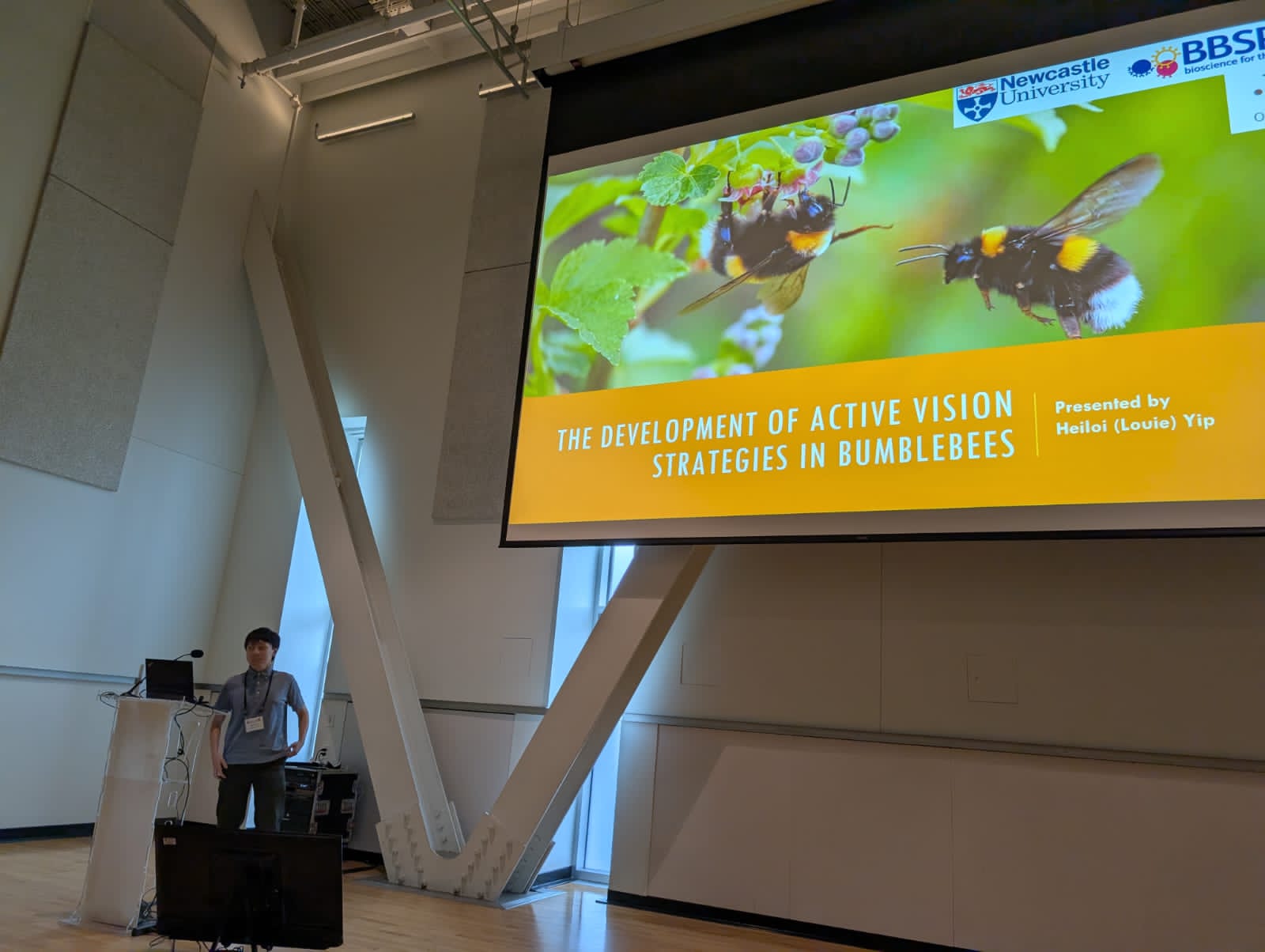
No prizes for guessing who's on the stage.
In the end, the conference proved to be the highest point of my PhD journey so far. I’ve had a lot of fun just from learning about the vast and wonderful science of neuroethology, coming to appreciate more of the fascinating biology of animals and the dedication of the many research teams actually making these findings. Throughout the conference I got to meet many fantastic people, such as professor Kentaro Arikawa of SOKENDAI, and many members of the Stöckl lab from the University of Konstanz. I even caught up with a few familiar faces whom I’ve met and known before the conference! The next ICN conference is scheduled to take place two years from now, and I will definitely be looking forward to another opportunity to attend.